


In today’s technology‑driven world, keeping devices powered and ready has never been more critical – especially in classrooms, offices and shared workspaces. One of the biggest shifts in recent years has been the rise of USB‑C as the dominant charging standard, and with good reason.
What Makes USB‑C Different?
USB‑C isn’t just another connector – it’s a versatile, universal interface that combines power delivery, data transfer and (in many cases) video connectivity into a single port. Unlike older USB types and proprietary chargers, USB‑C cables can be plugged in either way, eliminating the hassle of guessing orientation and reducing wear on ports.
One of the key innovations behind USB‑C is its support for USB Power Delivery (USB‑PD). With Power Delivery, devices can “negotiate” how much power they need, enabling faster and more efficient charging than older USB standards. This capability means that USB‑C can support everything from phones and tablets to higher‑powered laptops, all from the same type of port.

Why It Matters for Everyday Use
For schools, businesses and workplaces that rely on fleets of devices, USB‑C brings several practical advantages:
Simplified compatibility: With USB‑C as the common charging standard, one trolley or charging station can support many different device models and brands without needing multiple types of chargers.
Faster turnaround: USB‑C’s power delivery capabilities mean devices can go from low‑battery to ready‑to‑use more quickly, helping reduce downtime between lessons or meetings.
Ease of use: The reversible connector makes plugging in quick and frustration‑free, helpful in classrooms and busy environments where multiple users are connecting devices throughout the day.
These strengths make USB‑C not just a technical upgrade, but a practical one — cutting down on cable clutter, reducing the number of adapters needed, and ultimately saving time for teachers, IT staff and users alike.
The Bigger Picture — A Future‑Ready Standard
USB‑C is not just wide‑spread by coincidence, its adoption is being accelerated by global efforts to standardise charging ports across devices. In some regions, regulatory requirements are pushing manufacturers toward USB‑C for everything from phones and tablets to laptops and VR Headsets. This trend reinforces USB‑C’s role as the common denominator for charging technology, making it a smart choice for long‑term investments in charging infrastructure.
For organisations looking to streamline how they power devices, USB‑C charging trolleys represent a forward‑thinking solution. By combining the universal charging power of USB‑C with robust device organisation and intelligent features, they help ensure devices are ready when needed — without the chaos of tangled cables and mismatched adapters.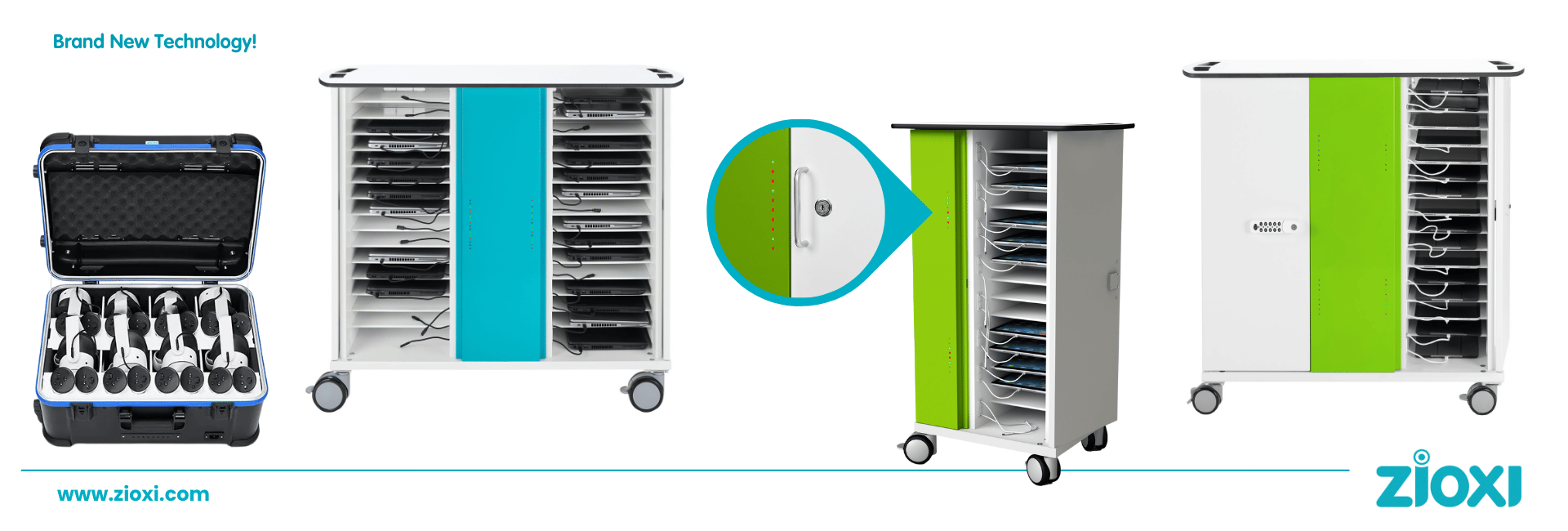
Zioxi USB-C Charging Solutions
Zioxi offers a range of USB-C charging trolleys to suit every device type:
iPads & Tablets: Secure storage and charging for 16–40 devices, with optional pre-fitted cables and locks.
Laptops: Trolleys supporting 16–32 devices, up to 60 W per port, with smart charging management options.
VR Headsets: Designed for multiple headsets and controllers, with neat cable management and secure storage.
- VR Headset Transporter Case: Safe storage and easy transport for 4 to 8 VR headsets and controllers.
Each trolley combines LED status lights, USB-C Power Delivery, and integrated cable management for fast, organised, and future-ready charging.
Zioxi is embracing the USB-C revolution with its latest charging trolley solutions, combining LED charging status lights, pre-fitted USB-C cables, and intelligent power delivery. These innovations make it easier than ever to keep devices organised, fully charged, and ready when they’re needed, reducing admin time, minimising device handling, and creating a future-proof solution for schools, offices, and shared workspaces.